![]() |
Touring bike, build up on an old road (~1970) Cr-mo frame.
In its latest incarnation equipped with Shimano 8-sp. MTB
drivetrain and Campy
Ergo-9 brifters. This was my first "serious" bicycle, on which I
rode my first long-distance rides back in St. Petersburg. Before
that, I did my trips on a single-speed general purpose
bicycle with a coaster brake. Originally this one had tubular
wheels, leather saddle, downtube friction shifters and 2x5 speeds.
Are you feeling nostalgic?
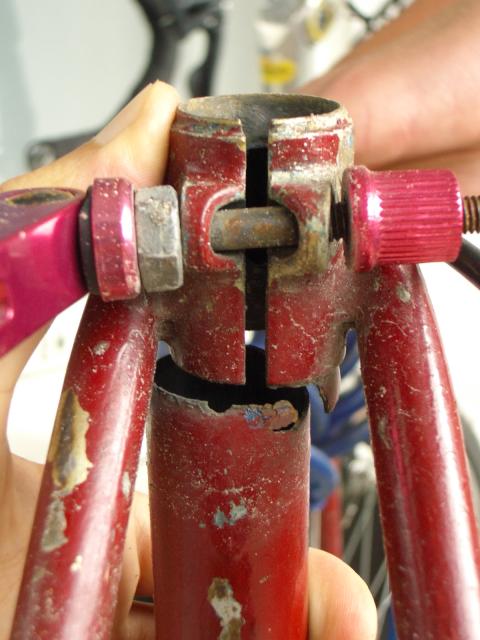
Later I replaced literally everything one-by-one, except the frame, which I was quite happy with. It was not as light as modern frames, but it took 37mm tyres and racks. It was also repainted and scratched, which made all bike look like a very low theft value -- a good feature for a touring. There is a dedicated page in Russian about the upgrade process and its technical particularities. This bike ended its life after trip in the Alps (2005). Returned home, I noticed that the seat tube was cracked under the top tube lug (picture). |
![]() |
Basic hybrid on hi-ten frame and C050 parts. It was my first
acquaintance with the world of modern bicycles. Worked for me
quite fine for 3 years, although it had not seen serious distances.
Later sold to a colleague, whom it still hopefully serves
well. Hybrid is a compromize between road bike and mountain bike,
and since as I have both, I don't feel that such compromize is
needed.
The thing I liked about it is the adjustable stem, which is a nice way to find your preference in the fitting of the bicycle. I found my own limit of handlebar position (about 5 cm under level of the saddle) and selected non-adjustable stems on my future bikes accordingly. |
![]() |
Bought used at a moving-sale price. Had "full German" equipment,
including Sachs drivetrain and Magura HS-33 hydraulical rim brakes,
of which I have
mixed impressions.
19" frame was small for me. I pulled the seatpost all the way to the
"max insertion" mark (or was it a bit over it?), and after some
time the seat tube cracked at the weld with the top tube.
No injury happened to the rider, i.e. me: I just heard
cracking sound while pedaling, thought it was coming from the
saddle. Only inspection at home revealed almost a 180 degrees
slit. I wonder how did it keep from complete failure during
the rest of the ride.
The frame was repaired in St. Petersburg. Now this bike is in use by my wife, whom it fits her much better. |
![]() |
After breaking the WM-team frame, I was looking for a replacement.
My requirement was solid fixtures for the rear rack. Surprisingly,
it turned out to be very difficult to find a decent frame designed
for racks! By coincidence, Alexey Kavelin aka Stranger was selling
his custom-made titanium frame together with a custom titanium rack
for it. The frame is made at MTI (Masters of Titanium
Production) Russian factory. As we are of almost same height and
weight, I took the chance to buy this frame, and found the
frame+rack combo perfect for my needs. I did not need titanium at
all and would be never paying extra for it (I neither participate
in races, where tens of seconds count, nor believe in folk tales
like "aluminium harsh ride"), but this frame turned out to be also
cheaper than comparable aluminium frames I considered, like Surly or Thorn.
(Later I found www.ciclib.de, making nice and affordable
aluminium frames for conventional or Rohloff hubs. That would be my
choice now.)
The rack is just the best one I ever saw. It is really one-piece welded titanium, which makes it much more rigid when fixed on the frame than "one size fits all" racks, connecting to the seatstays via thin sliding pieces. Most of my kilometers come from the daily 17km (one way) commute to work. For folks in rec.bicycles.tech, "commuting bike" means a roadbike, but in my conditions that is nonsence -- MTB with good suspension beats roadbike in the city in all aspects. |
![]() |
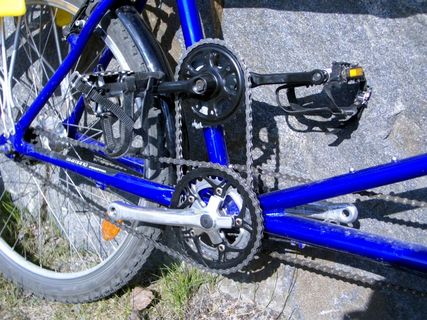
This monster has own page. It is a department-store 26" tandem, which is barely acceptable for two strong adults, but it was intended as a machine to carry 7-year old child. Equipped with kidback, this is one of my projects I am really proud of. |
![]() |
In Finland, internal gear hubs are quite popular. It is mostly
"grandma's bikes" which feature them, but high-mileage cyclists also
discuss their drawbacks and advantages up to the point that I
wanted to try one. I got salvaged old steel frame with
horisontal dropouts (rarity nowadays), unfortunately it was again
under my size. 400mm seatpost and extra-long high stem from
St. John's Street Cycles
made it possible for me to ride it more or less comfortably.
I have not became an advocate of Shimano Nexus-7 hub. Generally I liked everything in it, except that it can not downshift under load. So while climbing a hill, you must unload pedals for a moment to reduce the gear ratio, which overweighted advantages like immediate shifting and lower maintenance. As all of my bicycles took too much space in the bike storage room of our house, I put back original 7-speed equipment plus some upgrades and sold this bike to a friend at a bargain price. |
![]() |
After the frame of my first and only road/touring bike cracked (picture), I started search for a touring-like bicycle with the following properties:
Unfortunately in 2006 road groups down to 105 became 10-speed, which sounds like a big obstacle to me: there is no 10-speed MTB cassettes. Also the "added value", 16 tooth sprocket, is a nuisance; I can believe pro racers may benefit from it, but for me that's just a redundant click plus more expensive consumables. There is the classic touring Cannondale T800 satisfying my requirements, although a way overpriced with no visible reason (like all Cannondales are). This was a fallback solution; fortunately after long search I found the pictured "cyclocross" bike, with price half of Cannondale's and higher parts group: last-year 105, still 9 speed! The low-gear condition was not met though, it has lowest standard road 39/26 combination. But the left brifter is triple-compatible, and the upgrade to reasonable crankset, like 26/36/48, could be done at quite modest cost. Long live www.bicycles.de. The previous frame was definitely on the small side for me; now I again wanted to test the other extreme and ordered 62cm center-to-top frame size... and still had to replace the stock seatpost, which at its 25 cm was just a little bit too short. After the first test the stem was also replaced with much shorter and much higher one, just as I expected. In that setup, I rode quite comfortably 300 km brevet and 800 km ride over central Europe (2006), so I consider the question of fitting as "solved". |
![]() |
I heard many times that the Nexus-8 hub is a major improvement over Nexus-7. Once ciclib.de offered a 26" wheel built on Nexus-8 premium hub for the price less than hub alone in other shops. I could not resist a temptation to buy it, rationalizing that this may serve as an upgrade for our tandem. Before the next tandem season, I got for free a throwaway steel frame with horizontal dropouts from a local small bike repair shop, and installed the hub there in a similar manner as on now sold-out Nexus-7 26" bike. My straight feeling: I did not found any "major improvement". The hub has the same problem: downshift under load does not happen. Some jumps, notably from 5 to 4, are better than others, in the sense that they shift already under slightly relieved power. Others are just like in Nexus-7, i.e. complete release of pedaling force is necessary. The bike is still in daily use; this un-shifting is not crucial for commuting. But of course it does not make riding more pleasant. As I did not have any problems other people have with external deraileurs (like freezing in winter or just bad working), I see no benefit in planetar gear hubs for myself. |